Did a Younger Dryas Cataclysm Destroy an Advanced Civilization?
The file
This article draws on the episode above.
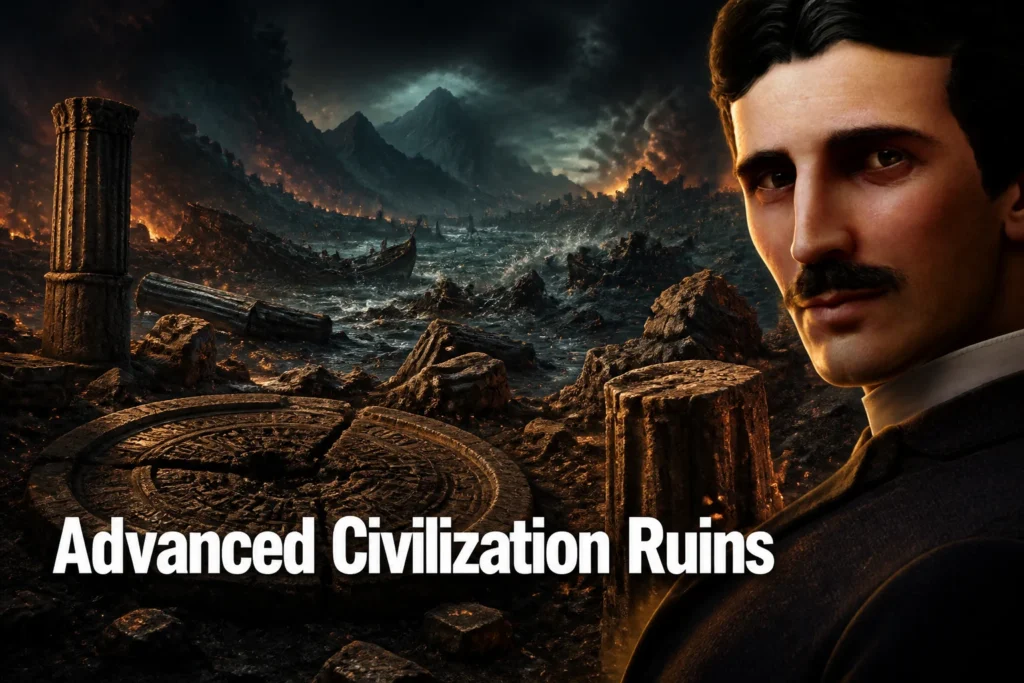
A vanished advanced civilization only makes sense in the episode’s telling if the destruction was fast, global, and brutal enough to erase both people and infrastructure in less than a week.
AJ Gentile frames that destruction as a planetary catastrophe, not a slow decline. He describes a violent plasma storm striking Earth, overwhelming the magnetosphere, and exposing the surface to lethal solar radiation while massive lightning hit with force hundreds or even thousands of times beyond an ordinary thunderstorm.
What was supposed to have happened during the cataclysm?
The episode says the disaster was a short, concentrated event that turned the planet hostile to life almost at once. AJ Gentile says the plasma storm left Earth exposed for four or five days (19:44), long enough for radiation, fire, and electrical violence to do damage on a civilizational scale.
“They didn’t slowly go extinct, they instantly went extinct.”
— AJ Gentile (19:38)
He applies that claim directly to large mammals such as saber toothed tigers and woolly mammoths. In the same account, survival depended on shelter. Animals able to go underground lived. Most humans died, and the people most likely to make it through were those near caves.
The physical traces named in the episode center on melted stone. AJ Gentile points to vitrified rock reported in over 120 countries (19:23), and he extends that claim to vitrification in moon rocks as well.
“This is called vitrification.”
— AJ Gentile (19:26)
The argument here is straightforward: if rock was heated so intensely that it turned glass-like, the episode treats that as evidence of an electrical event far beyond normal weather. That gives the story its mechanism for why a technologically capable society could disappear without leaving an easy, continuous record. Cities, tools, power systems, and people would not need centuries to vanish if the environment itself became lethal almost overnight.
How does the flood story fit the advanced civilization theory?
The flood is the second half of the episode’s case, and it is what turns a killing event into a world-resetting one. AJ Gentile says glaciers covered 30% of Earth’s surface (19:55), then describes them melting in a day or two and sending out floodwaters strong enough to scour stone monuments such as the Sphinx and the pyramids.
In that version of events, the flood does more than drown survivors. It strips landscapes, moves debris, buries settlements, and damages the kind of large architecture people usually expect to outlast a disaster. If an older advanced civilization had built with stone, the episode’s point is that even stone would not come through unchanged.
The article’s title asks whether such a civilization could have been destroyed, and the episode’s answer is yes, because the catastrophe combines radiation, fire, extinctions, and flood in one sequence. A clean-energy culture would be especially easy to lose from memory if its systems were smashed in the same few days that most of its population died.
AJ Gentile also says the theory has been around for 50 years (21:44). In the episode, that long shelf life matters because it places the idea in an existing body of speculation rather than presenting it as a brand-new claim.
Why do flood myths matter to the idea of an advanced civilization?
Flood myths matter in the episode because they are treated as cultural memory from people who survived the destruction and passed down a stripped-down version of what happened. The argument is not just that many cultures tell flood stories, but that those stories preserve a shared memory of a civilizational reset.
“Every culture has a flood myth that served as a reset of civilization.”
— AJ Gentile (20:25)
That line is where the episode leaves the subject. If the cataclysm happened the way AJ Gentile describes it, then the missing piece is not whether an advanced civilization could vanish, but how much of its memory could survive after radiation, lightning, extinction, and flood reduced the number of witnesses to a small group of cave-adjacent survivors. In that frame, the old stories are what remained after the technology did not.
Listen to the full episode
Listen to the full conversation on Spotify — the episode goes further than any article can, and following the show means you catch the next one.
 Watch this episode on YouTube ·
  Listen on Spotify · Subscribe to The Why Files: Operation Podcast
Links from this episode
Mentioned in the episode. Some of these may be affiliate or sponsored links.
- Taking care of your health just got easier – start here with my sponsor Zocdoc
- https://www.youtube.com/watch?v=Bn0nfqn9lYs
- https://www.youtube.com/watch?v=m6SEMpxDS-g
- http://www.gizapower.com
- https://www.smithsonianmag.com/smart-news/fall-equinox-secret-pyramids-near-perfect-alignment-180968223/
- https://www.wikiwand.com/en/World_Wireless_System
- https://www.wikiwand.com/en/Nikola_Tesla
- https://www.wikiwand.com/en/J._P._Morgan
- https://www.youtube.com/watch?v=hsYZhuz3wD0
- patreon.com/thewhyfiles
- shop.thewhyfiles.com
- thewhyfiles.com/discord