Are We Living in a Simulation? The Main Arguments, Clues, and Problems
The file
This article draws on the episode above.
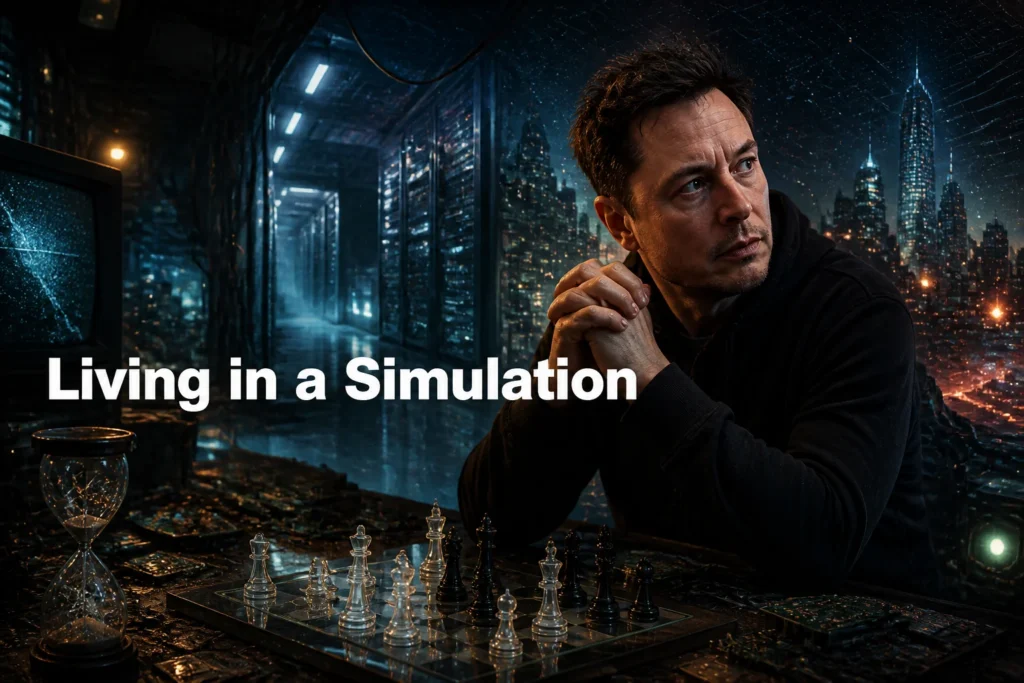
Nick Bostrom’s simulation argument gives you a clean answer before it gives you comfort: if advanced civilizations survive and build realistic ancestor worlds in large numbers, the odds tilt away from base reality and toward a constructed one.
Nick Bostrom’s 2003 paper laid out the version discussed here (0:33), and the conversation treats it as philosophy and metaphysics rather than settled science. That matters, because almost every clue people point to sits in the space between an intriguing idea and a proven claim.
What did Nick Bostrom actually argue about the simulation argument?
Nick Bostrom argued that one of three things has to be true: civilizations die before reaching the stage where they can build realistic world-models, they reach that stage and decide not to build them, or we are very likely inside one of those built worlds.
The ancestral angle drives the force of the idea. If a civilization becomes able to model conscious beings and entire histories, its own past becomes the obvious subject. You would not start with random worlds when your own origins are sitting there as the richest case to recreate. Once one civilization can do it, one simulation can also contain people who build more simulations, creating the Russian-doll effect the conversation leans on.
That is why the outside reactions named in the discussion sound so stark. Elon Musk put the odds that we are in base reality at 1 in billions (1:55). Neil deGrasse Tyson gave a much flatter estimate, saying the odds between base reality and a constructed world are 5050 (1:59). Those two reactions do not settle anything, but they show how the trilemma pushes people toward probability talk rather than laboratory proof.
The argument also asks you to think in terms of scale. If posthuman societies can run huge numbers of ancestor worlds, then simulated minds would outnumber original ones. In that setup, being in the minority case, the first untouched layer of reality, starts to look less likely than being in one of the copies.
Why do ancestor simulations matter so much to this idea?
Ancestor simulations matter because the whole case gets stronger once you assume advanced beings would want to recreate their own history, not just invent fantasy worlds.
The conversation treats that as the natural next step of any civilization with enough power and curiosity. A culture that can model conscious lives in detail would have a reason to revisit wars, migrations, extinctions, religions, and ordinary family life. You could study where your society came from, test alternate outcomes, and watch long stretches of history unfold under controlled conditions.
The scale problem follows immediately. A single original civilization might create many versions of its past, and each one could host beings who eventually build more layered worlds of their own. That multiplication effect is what gives Bostrom’s trilemma its pressure. The claim is not that one fake world exists. The claim is that if such worlds can exist and are actually made, they can exist in enormous numbers.
“The Big Bang, that was the simulation booting up.”
— AJ Gentile (20:20)
That line captures how far the idea extends once you accept the premise. The start of the universe stops looking like an ultimate beginning and starts looking like an initialization event. The discussion keeps this in speculative territory, but the logic stays the same throughout: if the world has a maker outside it, then the beginning of time inside the world does not have to be the beginning for the maker.
“They don’t have to follow the laws of physics.”
— AJ Gentile (20:36)
That is the escape hatch built into the argument. A creator outside the system would not be trapped by the system’s rules any more than a game designer is trapped by gravity inside the game.
Do Mandela Effect memories count as evidence of a simulation?
Mandela Effect memories count here as suggestive glitches in memory and reality, not as proof that the world is programmed.
The named example is Nelson Mandela. Some people remember a two hours televised funeral procession for him, even though reality does not match that memory (5:26). From there the discussion runs through the stock list that keeps resurfacing online: the Monopoly monocle, Luke, I am your father, Mirror, mirror, Jiffy peanut butter, the Fruit of the Loom cornucopia, and Dolly’s braces in Moonraker.
The reason these examples matter to believers is simple. The memories often feel shared, vivid, and strangely stubborn. If lots of people recall the same wrong detail, the temptation is to stop calling it ordinary error and start calling it a clue. The conversation folds that feeling into the broader simulation argument by treating mismatched memories as signs of edited code, overwritten branches, or inconsistent rendering.
Philip K. Dick’s version is more specific. He tied déjà vu to altered timelines or changes in the structure beneath lived reality. In that frame, the weirdness is not just bad recall. It is a moment where the script has been revised and some people still feel the seam.
None of that turns memory anomalies into established science. The discussion does not present them that way. It presents them as the kind of recurring oddity that keeps the larger question alive.
Why does the Fermi paradox keep getting pulled into the simulation argument?
The Fermi paradox fits the simulation argument because a universe that looks huge and old should, by straightforward expectation, be crowded with advanced life.
The conversation puts the contrast in blunt terms. After 14 billion years, the universe has produced galaxies, planets, ice cream, and K-pop (2:54). It also contains 200 billion trillion stars (8:03). On top of that, the Drake equation is described as implying over 1,000,000 technologically advanced civilizations in our Galaxy, with the nearest one on average only a few 100 light years away (8:13).
Yet the sky stays silent.
That silence is where the simulation reading enters. If intelligent life should be common and nearby by those assumptions, then one answer is that the world is not being rendered as a fully populated cosmos. You only see the amount of universe required for the experience you are having. Empty distances, missing visitors, and the absence of obvious alien engineering start to look less like a paradox of life and more like a design choice.
The discussion does not claim that this solves the Fermi paradox in any scientific sense. It uses the paradox as pressure on the ordinary picture. If the numbers push one way and observation pushes the other, a simulated universe becomes one way to square the mismatch.
Does the double-slit experiment prove we live in a simulation?
The double-slit experiment does not prove a programmed universe in the discussion, but it is treated as one of the strongest physics analogies for reality behaving differently when measured.
The basic appeal is obvious. At the quantum level, particles seem to act one way when unobserved and another way when a measurement is made. That sounds, to people drawn to the idea, less like a passive world and more like a system that resolves detail when someone checks it.
“This is called retro causality.”
— AJ Gentile (19:17)
The specific claim attached to that phrase is that measuring light now can seem to affect what that light was doing long before the measurement took place. The conversation uses an example of photons from a galaxy 100 million light years away (18:55). In the telling here, the measurement appears to reach back through 100 million years (19:19), as though the result is being fixed after the fact rather than carried all the way in a settled state.
That supports the rendering analogy. A programmer does not need to calculate every distant event in full detail at every moment if those details only matter once a user observes them. On that reading, far-off galaxies are filled in when somebody points an instrument at them, the same way a game engine saves resources by drawing what the player can actually see.
The conversation still keeps one foot on the brake: this is interpretation, not proof. Quantum weirdness is real in the discussion. The leap from weirdness to a designed simulation remains a philosophical move.
Can you ever disprove a simulated universe?
A simulated universe is hard to disprove in this account because any evidence against it can be absorbed as part of the simulation itself.
“Convenient case for simulation theory is, you can’t disprove it.”
— AJ Gentile (20:20)
That is the core problem the conversation invites, and it is also the reason the subject stays lodged between philosophy, metaphysics, and science fiction. If every observation you make comes from inside the system, then the system can always be said to include the observation, the instruments, and your reasoning about both.
That circular quality changes the kind of claim this is. A normal scientific claim risks failure in a lab or in the field. A simulation claim often survives by moving the creator one level farther out. If a law of physics looks fixed, the law was coded that way. If a result looks messy, the code allows noise. If reality surprises you, the builder chose surprise.
The discussion does not resolve that problem. It leaves it standing. That is consistent with the way the topic is framed from the start: not as established science, but as a metaphysical possibility that gathers force from probability arguments, memory anomalies, cosmic silence, and quantum behavior.
Is simulation theory basically a modern version of God?
The conversation says the overlap is hard to miss, because a simulator would be an intelligence outside space and time that creates the world and sets its rules from beyond it.
Once the maker sits outside the universe, the old theological shape appears in updated language. The creator does not have to live under the clock inside creation. The creator can start the system, alter it, suspend rules within it, or let conscious beings act freely while still depending on a reality beyond their own.
The ancestral-simulation model gives that old idea a technical skin. Instead of miracles, you get interventions from outside the environment. Instead of creation from nothing, you get a world initialized by a higher intelligence. Instead of divine omniscience, you get total access to the code and every state within it.
The discussion stops there rather than turning the overlap into a doctrine. The practical move is not to pretend the question has been settled. It is to recognize what kind of question it is. If you follow the episode’s line all the way through, you end up with a possibility that can borrow from cosmology, quantum mechanics, memory glitches, and philosophy without becoming identical to any one of them.
Listen to the full episode
Listen to the full conversation on Spotify — the episode goes further than any article can, and following the show means you catch the next one.
 Watch this episode on YouTube ·
  Listen on Spotify · Subscribe to The Why Files: Operation Podcast
Links from this episode
Mentioned in the episode. Some of these may be affiliate or sponsored links.
- Taking care of your health just got easier – start here with my sponsor Zocdoc
- patreon
- shop.thewhyfiles.com
- thewhyfiles.com/discord
- 🌐 OFFICIAL WEB SITE
- thewhyfiles.com/tips
- thewhyfiles.com/merch
- thewhyfiles.com/wild
- thewhyfiles.com/podcast
- reddit.com/r/TheWhyFiles/
- twitter.com/OMGTheWhyFiles
- instagram.com/OMGTheWhyFiles