What Did Nikola Tesla Have in Common With the Great Pyramid?
The file
This article draws on the episode above.
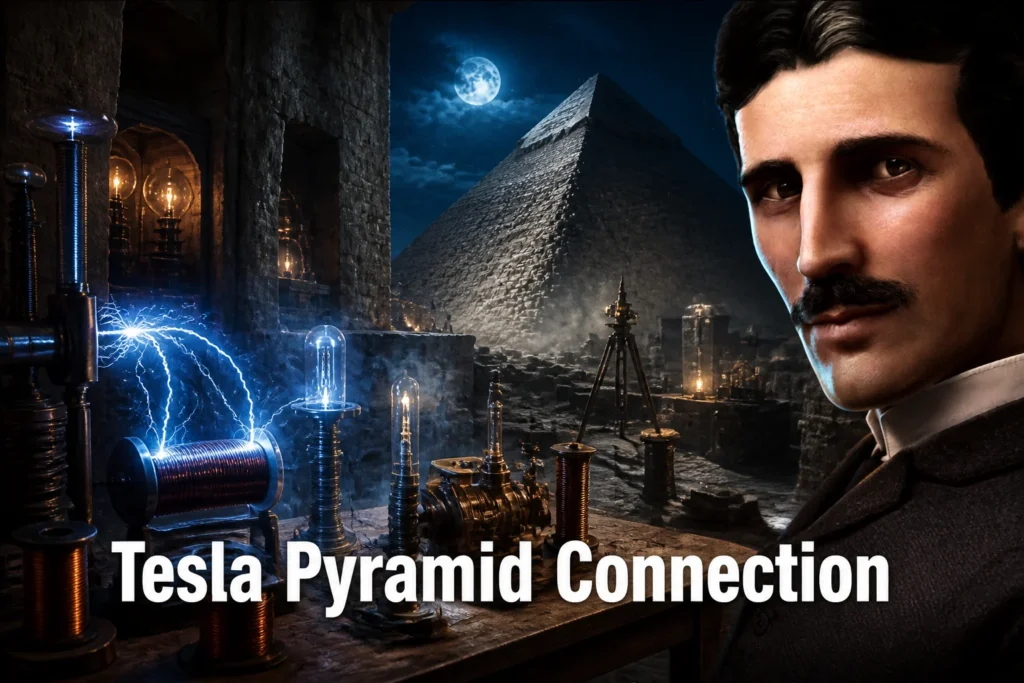
Nikola Tesla and the Great Pyramid are linked in the episode by one big claim: both were built around the same idea of wireless power, with energy drawn through the Earth and pushed outward without wires.
The comparison stays narrow and specific. It does not try to prove every pyramid theory at once. It ties Tesla’s work at Wardenclyffe to a handful of physical details at Giza and treats the pyramid as an ancient version of the system Tesla was chasing.
What did Nikola Tesla and the Great Pyramid have in common?
The episode says Nikola Tesla and the Great Pyramid shared the same basic purpose: using the Earth itself as part of a wireless power system.
Tesla is described as believing he could pull energy from inside the Earth and transmit it wirelessly around the world. The Great Pyramid is framed in almost the same terms, not as a tomb in this comparison but as a structure designed to work with resonance, geology, and the movement of energy through the ground.
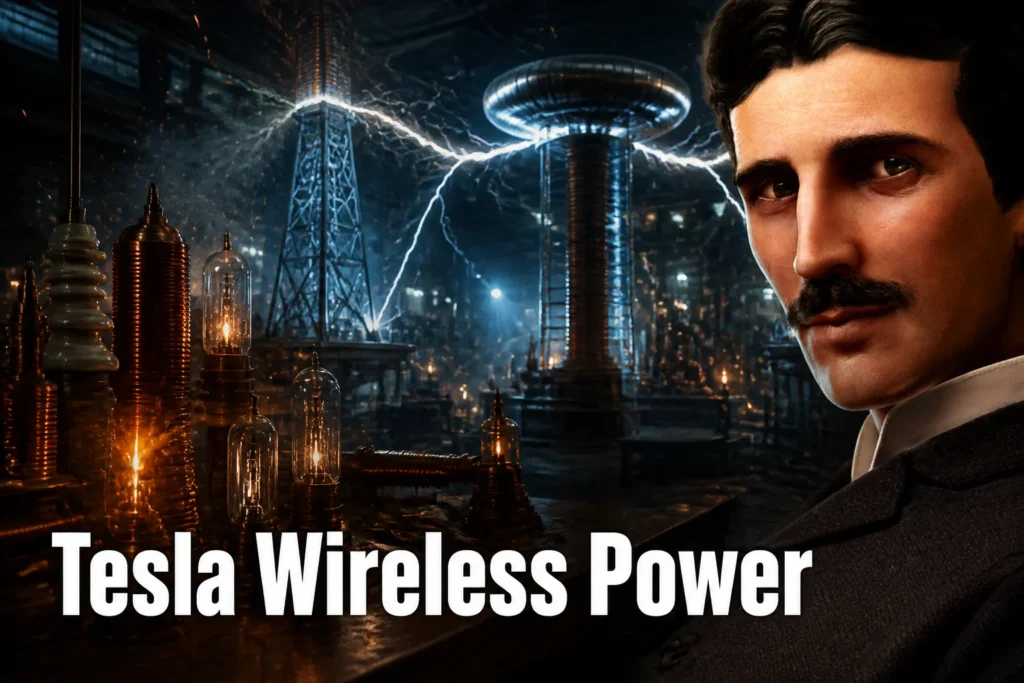
The cleanest link is Wardenclyffe Tower. The episode compares Wardenclyffe and the pyramid directly, saying both were built over aquifers and both relied on the Earth’s resonance. In that telling, the ground under the structure was not incidental. It was part of the machine.
That matters because the shared logic is mechanical, not symbolic. You place a structure over moving water, couple it to the Earth, and use resonance to amplify or direct energy. The pyramid, in this account, was not simply massive stone stacked for display. It functioned more like a giant instrument tuned to interact with the planet beneath it.
“There is no evidence left of Tesla’s wireless power technology.”
— AJ Gentile (0:20)
The comparison still rests on what the episode says Tesla was trying to do, not on surviving hardware you can inspect today. That absence is part of why the pyramid link attracts so much attention: the argument treats both projects as fragments of the same lost approach to power.
How does the episode connect Wardenclyffe Tower to the pyramid?
The episode connects Wardenclyffe Tower to the pyramid by saying both structures were designed to use resonance, water below the ground, and conductive materials inside the build itself.
On the pyramid side, the details are tightly focused. The chambers are described as containing quartz-rich granite, which the episode treats as important because quartz is tied to vibration and resonance in the theory. It also points to a resonance at 440 Hertz and the musical note F#, presenting the Great Pyramid less like a static monument and more like a tuned device.
That is where the power-plant comparison sharpens. The structure is described as behaving like a giant power plant or even a musical instrument, with its stone, internal spaces, and placement all contributing to a resonant effect. In that model, the pyramid does not just sit on the landscape. It interacts with it.
The episode adds newer physical claims from the site: copper pipes and iron rods have recently been discovered at the pyramid site. In the comparison being made, those materials matter because copper and iron fit the broader idea of collection, conduction, or transfer of energy. The same section of the argument also includes a gold capstone, with the claim that it could have transmitted energy into the atmosphere.
Taken together, those pieces form the Great Pyramid connection the episode wants you to see. Wardenclyffe was Tesla’s modern attempt to build a planet-scale wireless system. The pyramid, in this reading, was an earlier version built with stone, metal, groundwater, and resonance instead of modern industrial materials.
Why does Tesla’s funding story matter to the pyramid comparison?
Tesla’s funding story matters because the episode uses it to show where his project split from ordinary communication technology and moved toward the same kind of wireless power system the pyramid is said to represent.
The episode says J.P. Morgan funded Tesla in 1900 for wireless communication. Then support was withdrawn when Tesla shifted toward transmitting power. That turn is central to the comparison, because it places Tesla beyond radio signals and into a much larger ambition: sending usable energy without wires across great distances.
Once the article stays on that point, the Great Pyramid connection becomes the endpoint of the argument. If Tesla was not simply trying to improve communication but to move power through the Earth and atmosphere, then Wardenclyffe starts to resemble an industrial-age echo of a much older machine.
“Tesla didn’t invent wireless power.”
— AJ Gentile (0:30)
The episode closes the circle by treating Tesla less as the first mind to imagine the idea than as someone rediscovering it. Speaker 1 says wireless power has been here for 5000 years (0:36). In this framing, the Great Pyramid was not a strange parallel to Tesla’s work. It was the earlier template.
Listen to the full episode
Listen to the full conversation on Spotify — the episode goes further than any article can, and following the show means you catch the next one.
 Watch this episode on YouTube ·
  Listen on Spotify · Subscribe to The Why Files: Operation Podcast
Links from this episode
Mentioned in the episode. Some of these may be affiliate or sponsored links.
- Taking care of your health just got easier – start here with my sponsor Zocdoc
- https://www.youtube.com/watch?v=Bn0nfqn9lYs
- https://www.youtube.com/watch?v=m6SEMpxDS-g
- http://www.gizapower.com
- https://www.smithsonianmag.com/smart-news/fall-equinox-secret-pyramids-near-perfect-alignment-180968223/
- https://www.wikiwand.com/en/World_Wireless_System
- https://www.wikiwand.com/en/Nikola_Tesla
- https://www.wikiwand.com/en/J._P._Morgan
- https://www.youtube.com/watch?v=hsYZhuz3wD0
- patreon.com/thewhyfiles
- shop.thewhyfiles.com
- thewhyfiles.com/discord