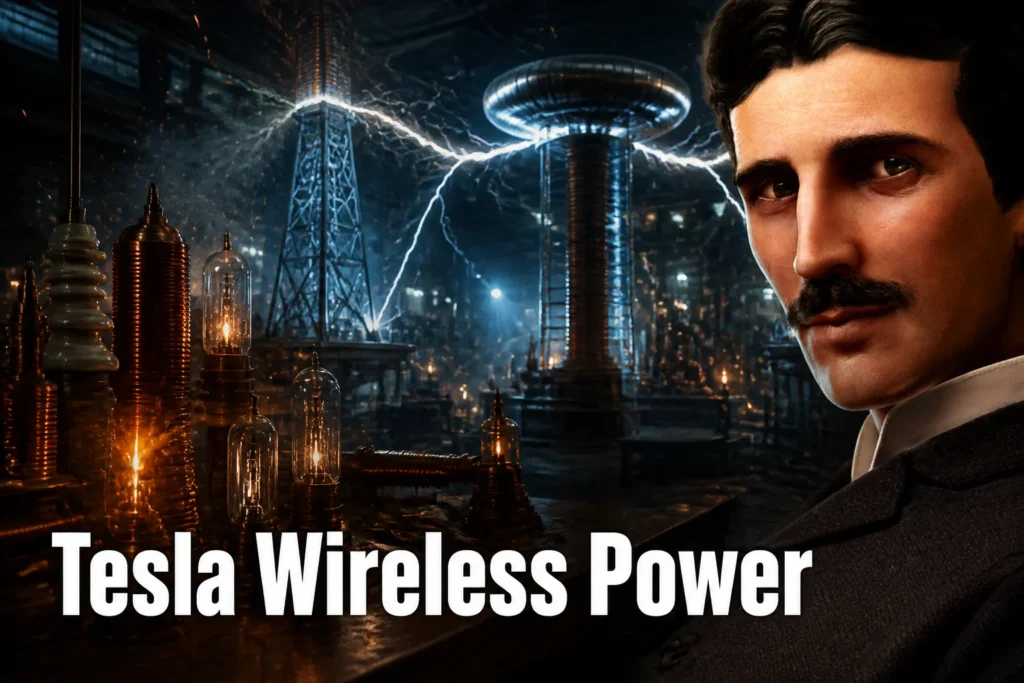
Why Do People Think Tesla’s Wireless Power Project Was Shut Down?
The file
This article draws on the episode above.
Support for Tesla wireless power didn’t collapse in this account because the idea sounded too strange. The episode ties the break to money, control, and one sharp turn in purpose: Nikola Tesla had backing for wireless communication, then lost it when he pushed toward sending power instead.
Nikola Tesla is the person at the center of the story, and J.P. Morgan is the financier the episode places opposite him. The episode says Morgan funded Tesla in 1900 for communication work, not for a system that could move usable energy through the air to people who might never need a meter, a wire, or a monthly bill.
Why the episode says Morgan stopped backing Tesla
The episode says J.P. Morgan backed Nikola Tesla for one business case and pulled away when Tesla aimed at another. In that telling, Morgan agreed to support wireless communication in 1900, but withdrew support once Tesla tried to turn the project into wireless energy transmission.
That distinction does almost all the work in the episode’s argument. Communication still fits inside a familiar business structure. Power is different. If Tesla could send electricity without the normal delivery system, the episode says the project stopped looking like an investment and started looking like a threat to the industries already built around selling energy through controlled networks.
The episode goes further than a simple funding dispute. It says Morgan did not merely lose interest, but blacklisted Tesla after the project shifted toward power transmission. Presented that way, the problem was not technical confusion alone. The problem was that Tesla had moved toward something too disruptive to existing business interests, especially if it opened the door to energy that was cheap, widely available, and hard to monopolize.
The episode treats that as an interpretation of motive, not a settled historical verdict. Still, its claim is clear: once Tesla’s work threatened the economics of energy rather than serving the economics of communication, elite support dried up fast.
Why wireless energy looked dangerous to entrenched industries
The episode says opposition to Tesla wireless power makes sense once you place it inside the modern energy economy. Its broad point is that a system promising cheap clean energy would not have challenged one inventor or one investor alone; it would have challenged the structure of entire industries.
To frame that pressure, the episode points to a present-day energy fact: 84% of the world’s energy is created from fossil fuels. It uses that figure to argue that any technology offering energy outside the usual fuel, grid, and billing model would threaten interests with enormous financial and political weight behind them.
In the episode’s version of events, that is the real suppression narrative. The resistance was not just about whether Tesla could build something impressive. It was about what would happen if he succeeded. A working form of wireless power could weaken the hold of industries tied to coal and oil, and the episode says those industries had every reason to defend the system that already enriched them.
That is why the story stays focused on motive. The episode is not trying to walk you through coils, towers, or engineering details here. It is arguing that once energy entered the picture, Tesla was no longer proposing a clever communication upgrade. He was stepping into a fight with the business model of modern power itself.
Why people still think Tesla’s wireless power was shut down
People still return to this suppression story because the episode ends on what happened to Nikola Tesla himself. It says Tesla died alone and broke, and it uses that ending to reinforce the idea that his cheap clean energy technology died with him while the world moved instead toward coal and oil.
The emotional force matters because it turns an industrial dispute into a cautionary pattern. The episode’s closing suggestion is that what people are seeing now could be what happened to Tesla 100 years ago (22:09): a breakthrough with huge public value meets resistance because it threatens established systems that already control money and infrastructure.
That doesn’t prove every part of the suppression claim by itself, and the episode does not frame it as courtroom evidence. What it does is connect a financier, a change in project goals, a fossil-fuel-heavy energy system, and Tesla’s lonely end into one narrative people remember. For viewers who accept that chain, the project was not simply abandoned or misunderstood. It was opposed once wireless communication started to look like wireless power.
Listen to the full episode
Listen to the full conversation on Spotify — the episode goes further than any article can, and following the show means you catch the next one.
 Watch this episode on YouTube ·
  Listen on Spotify · Subscribe to The Why Files: Operation Podcast
Links from this episode
Mentioned in the episode. Some of these may be affiliate or sponsored links.
- Taking care of your health just got easier – start here with my sponsor Zocdoc
- https://www.youtube.com/watch?v=Bn0nfqn9lYs
- https://www.youtube.com/watch?v=m6SEMpxDS-g
- http://www.gizapower.com
- https://www.smithsonianmag.com/smart-news/fall-equinox-secret-pyramids-near-perfect-alignment-180968223/
- https://www.wikiwand.com/en/World_Wireless_System
- https://www.wikiwand.com/en/Nikola_Tesla
- https://www.wikiwand.com/en/J._P._Morgan
- https://www.youtube.com/watch?v=hsYZhuz3wD0
- patreon.com/thewhyfiles
- shop.thewhyfiles.com
- thewhyfiles.com/discord