Do Flood Myths Point to a Real Ancient Catastrophe?
The file
This article draws on the episode above.
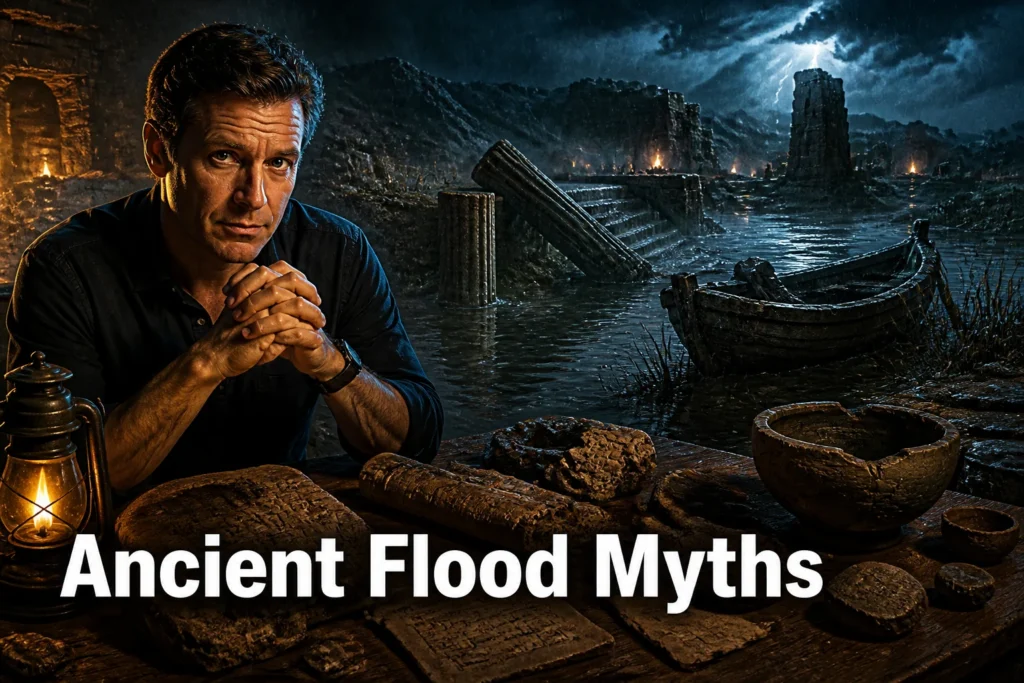
A pile of flood stories from scattered cultures is where the episode starts, and the speaker says ancient flood myths begin to look different when you stop treating them as isolated legends. The case laid out here stays narrow: not that every story proves a single worldwide deluge, but that repeated accounts, paired with a few physical clues, can sound less like pure invention and more like memory carried forward for a very long time.
The episode’s thread is simple. If people in many places remembered destructive water, and if some geology lines up with that memory, then the idea of an ancient catastrophe stays hard to dismiss. That is the frame the speaker uses while moving from flood traditions to regional evidence in China, the Mediterranean, and the Black Sea, and then to older dates proposed by Thomas.
Why do ancient flood myths keep coming up?
The speaker says the recurring pattern matters because many separate traditions tell some version of the same basic event: overwhelming water, survival by a few, and a world remade afterward. In the episode’s telling, ancient flood myths gain weight once the count reaches 40, because that many stories spread across cultures starts to look less like random folklore and more like distorted history.
The argument stays careful. The speaker does not treat the stories as courtroom proof, and he does not say every culture is remembering the exact same flood. He treats them as possible cultural memory, the kind of memory that changes shape over time while still preserving a core event.
That distinction matters to the whole discussion. A local disaster can become sacred story. A regional catastrophe can turn into a tale about gods, judgment, survival, and a new beginning. The episode keeps that possibility open instead of trying to force every tradition into one neat timeline.
The speaker also ties that pattern of repeated stories to why catastrophe theories keep resurfacing. If flood accounts appear again and again, people naturally start asking whether those stories point back to real events. The show’s answer is not a firm yes. The show’s answer is that repetition, by itself, keeps the question alive.
What evidence did the episode connect to a real ancient flood?
The episode connects the flood-story pattern to regional discoveries that it says support a major inundation sometime between 6500 and 7000 years ago. The places named are China, the Mediterranean, and the Black Sea, and the speaker presents them as pieces that fit the same broad possibility: major flooding happened in human memory, even if not as one single globe-covering event.
The Black Sea sits near the center of that case. In the episode’s framing, evidence from that region helps explain why a large flood could leave such a deep mark on the stories people told afterward. China and the Mediterranean extend the point by suggesting that destructive water events were not confined to one isolated setting.
The speaker then places those later floods beside Thomas’s longer catastrophe chronology: about 11,500, 18,500, 29,000, and 43,800 years ago. He presents those dates as part of Thomas’s attempt to map repeating upheavals rather than as settled fact. One date gets a specific link in the episode: the 18,500-year point is said to match the time when the Bering Land Bridge went underwater.
That connection is used as a suggestive overlap, not a final demonstration. The episode’s case depends on convergence. Stories recur, certain regions show signs of major flooding, and Thomas proposed older cataclysm dates that the speaker says sometimes line up with known changes in the physical world.
Why the Sphinx shows up in a flood myths discussion
The Sphinx enters the conversation as a physical clue the episode treats as intriguing but unproven. The speaker says erosion at the base of the Great Sphinx looks like running-water erosion, and in the logic of the episode that would place the monument before the last great flood being discussed, perhaps even before Egyptian civilization itself.
The claim is not presented as settled archaeology. It is presented as one of those stubborn anomalies that keep catastrophe ideas in circulation. If a structure appears to show signs of heavy water exposure from a much wetter period, then people who already suspect ancient disasters see it as one more fragment that does not fit the ordinary timeline cleanly.
The show uses the Sphinx the same way it uses the flood traditions and the regional geology: as suggestive evidence. The speaker does not claim the monument proves Thomas right. He uses it to show why the public imagination keeps returning to lost worlds, erased histories, and civilizations interrupted by forces large enough to survive only as stories.
That leaves the article in the same place the episode leaves the subject. Repeated flood traditions, regional evidence from several parts of the world, Thomas’s sequence of earlier cataclysm dates, and unusual wear on an ancient monument do not close the case, but together they keep the ancient catastrophe idea alive.
Listen to the full episode
Listen to the full conversation on Spotify — the episode goes further than any article can, and following the show means you catch the next one.
 Watch this episode on YouTube ·
  Listen on Spotify · Subscribe to The Why Files: Operation Podcast
Links from this episode
Mentioned in the episode. Some of these may be affiliate or sponsored links.
- Taking care of your health just got easier – start here with my sponsor Zocdoc
- https://amzn.to/3WbeRYJ
- https://amzn.to/3GR2pJc
- https://amzn.to/3GloaiI
- https://www.bibliotecapleyades.net/ciencia3/historia_humanidad267.htm
- https://www.wikiwand.com/en/2012_(film
- https://www.nasa.gov/topics/earth/features/2012-poleReversal.html
- https://www.wikiwand.com/en/Younger_Dryas
- https://www.wikiwand.com/en/Mu_(lost_continent
- https://www.wikiwand.com/en/Cataclysmic_pole_shift_hypothesis#/Earth_crustal_displacement_hypothesis
- https://www.wikiwand.com/en/Supercontinent
- https://www.wikiwand.com/en/James_Churchward