Christopher Dunn’s Great Pyramid Power Plant Theory, Step by Step
The file
This article draws on the episode above.
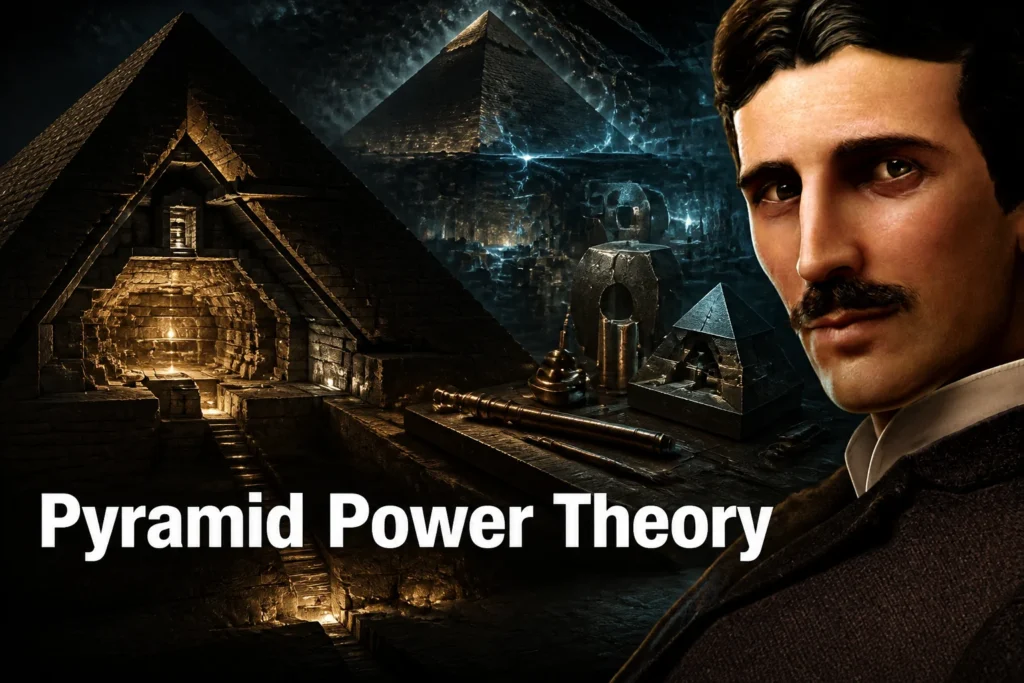
Water under the Great Pyramid, sound moving up through stone, hydrogen filling hidden spaces: Christopher Dunn’s pyramid power theory is built as a machine, not a monument. In the account presented here, the structure works step by step, with each chamber doing a separate job inside one larger system.
Christopher Dunn is the person at the center of this theory, and the Great Pyramid is the place every claim is attached to. The mechanism described links aquifers beneath the monument, the Queen’s Chamber, the Grand Gallery, and the King’s Chamber into one chain of sound, chemistry, pressure, and electrical effects.
How does Christopher Dunn’s pyramid power theory work?
Christopher Dunn’s pyramid power theory begins below the monument, where aquifers are said to generate sound waves that travel upward into the body of the Great Pyramid. In the version laid out in the episode, the pyramid does not start with sunlight or static charge. It starts with moving water and vibration.
That first vibration matters because the rest of the mechanism depends on resonance. The aquifers supply the driving energy at the base level, and the chambers above are treated as tuned spaces designed to respond to it. The idea is that the pyramid’s builders shaped internal rooms and passages so those vibrations would not just pass through, but build in strength as they moved.
The next stop in the chain is the Queen’s Chamber. There, the episode places a chemical process at the center of Dunn’s design. Hydrochloric acid and hydrated zinc chloride are said to react in that chamber and produce hydrogen. In this reconstruction, the Queen’s Chamber is not presented as symbolic space or burial space. It is treated as a reaction chamber with a specific output: hydrogen gas.
Once created, that hydrogen is said to move onward into the Grand Gallery. The theory then shifts from chemistry to pressure and acoustics. The gas does not simply collect there. The Grand Gallery is described as a place where pressure and resonance work together, so the energy already moving through the pyramid can interact with the hydrogen in a controlled way. Dunn’s pyramid power theory, as described in the episode, depends on that sequence holding together: groundwater creates sound, sound feeds resonance, chemistry creates hydrogen, and the upper chambers convert those conditions into electrical effects.
The Grand Gallery and King’s Chamber as an acoustic engine
The Grand Gallery is presented as the main acoustic amplifier in Christopher Dunn’s pyramid power theory, with a design tuned so precisely that the episode treats it like engineered audio hardware built at monumental scale. The details given are unusually specific, and they are the backbone of the argument.
According to the episode, the Grand Gallery contained 27 or 28 pairs of resonators. That number matters because the chamber is not described as empty architectural volume. It is described as a loaded system, with repeated components positioned to respond to vibration and help sustain resonance inside the structure.
The frequency attached to the Grand Gallery is 440 Hertz. The episode also says the chamber naturally emits an F# chord. That pairing is part of how the theory frames the gallery: not just as a passage, but as a resonant cavity tuned to a measurable pitch. The claim is then extended to the King’s Chamber, which is also said to resonate at 440 Hertz and F#.
“The entire complex is a giant musical instrument.”
— AJ Gentile (9:04)
AJ Gentile uses that line to tie the chambers together into one idea rather than a set of isolated claims (9:04). In this telling, the Great Pyramid behaves like a single acoustic body. The Grand Gallery resonates. The King’s Chamber resonates. Their matching pitch supports the larger claim that the whole structure was designed to vibrate as one system.
The episode pushes the point further by calling the pyramid a Helmholtz resonator. That comparison places the Great Pyramid in the same family as devices that respond to sound through the movement of air in a cavity with a defined opening and volume. In Dunn’s mechanism, the stone mass, enclosed chambers, and internal passages are not accidental forms. They are the parts that make resonance useful.
That is also where electricity enters the story. Hydrogen reaching the Grand Gallery is said to encounter a space already shaped by pressure and tuned vibration. The theory presented is that those conditions allow electrical generation to happen, with acoustic architecture doing more than carrying sound. It acts as the control system for the conversion process.
Why the theory points to modern resonance studies
The modern research brought into Christopher Dunn’s pyramid power theory is there to connect the ancient structure with present-day language about resonance, electromagnetic concentration, and electrical behavior in stone. The episode does not treat these studies as proof of the whole mechanism by themselves. It uses them as support for parts of the chain.
One study named in the episode is a 2018 experiment reporting that, in a resonant state, the pyramid can concentrate electromagnetic energy in its internal chambers and under its base. The same account says resonance in that experiment was induced by radio waves from 200 to 600 meters. Inside the logic of the theory, that matters because it suggests pyramid geometry can focus energy into particular regions instead of dispersing it evenly.
The second study named is a 2019 paper titled A Large Scale Thermal Acoustic Generator. The episode says that paper described how vibrating granite and other rocks can cause electrons to migrate through the rock to the surface. That detail is used to connect the Great Pyramid’s granite components with a possible physical route from vibration to electrical behavior.
Put together, those studies serve a narrow role in the argument. One points to concentrated electromagnetic effects in and under the pyramid during resonance. The other points to rock vibration producing electron movement. Dunn’s pyramid power theory uses those findings to join four kinds of claims that are often discussed separately: aquifers as the source of sound, the Queen’s Chamber as the site of hydrogen production, the Grand Gallery and King’s Chamber as tuned acoustic spaces, and the stone itself as part of an electrical process.
The result is a single mechanical story about the Great Pyramid. Water starts it. Chemistry feeds it. Resonance shapes it. Granite helps finish it.
Listen to the full episode
Listen to the full conversation on Spotify — the episode goes further than any article can, and following the show means you catch the next one.
 Watch this episode on YouTube ·
  Listen on Spotify · Subscribe to The Why Files: Operation Podcast
Links from this episode
Mentioned in the episode. Some of these may be affiliate or sponsored links.
- Taking care of your health just got easier – start here with my sponsor Zocdoc
- https://www.youtube.com/watch?v=Bn0nfqn9lYs
- https://www.youtube.com/watch?v=m6SEMpxDS-g
- http://www.gizapower.com
- https://www.smithsonianmag.com/smart-news/fall-equinox-secret-pyramids-near-perfect-alignment-180968223/
- https://www.wikiwand.com/en/World_Wireless_System
- https://www.wikiwand.com/en/Nikola_Tesla
- https://www.wikiwand.com/en/J._P._Morgan
- https://www.youtube.com/watch?v=hsYZhuz3wD0
- patreon.com/thewhyfiles
- shop.thewhyfiles.com
- thewhyfiles.com/discord