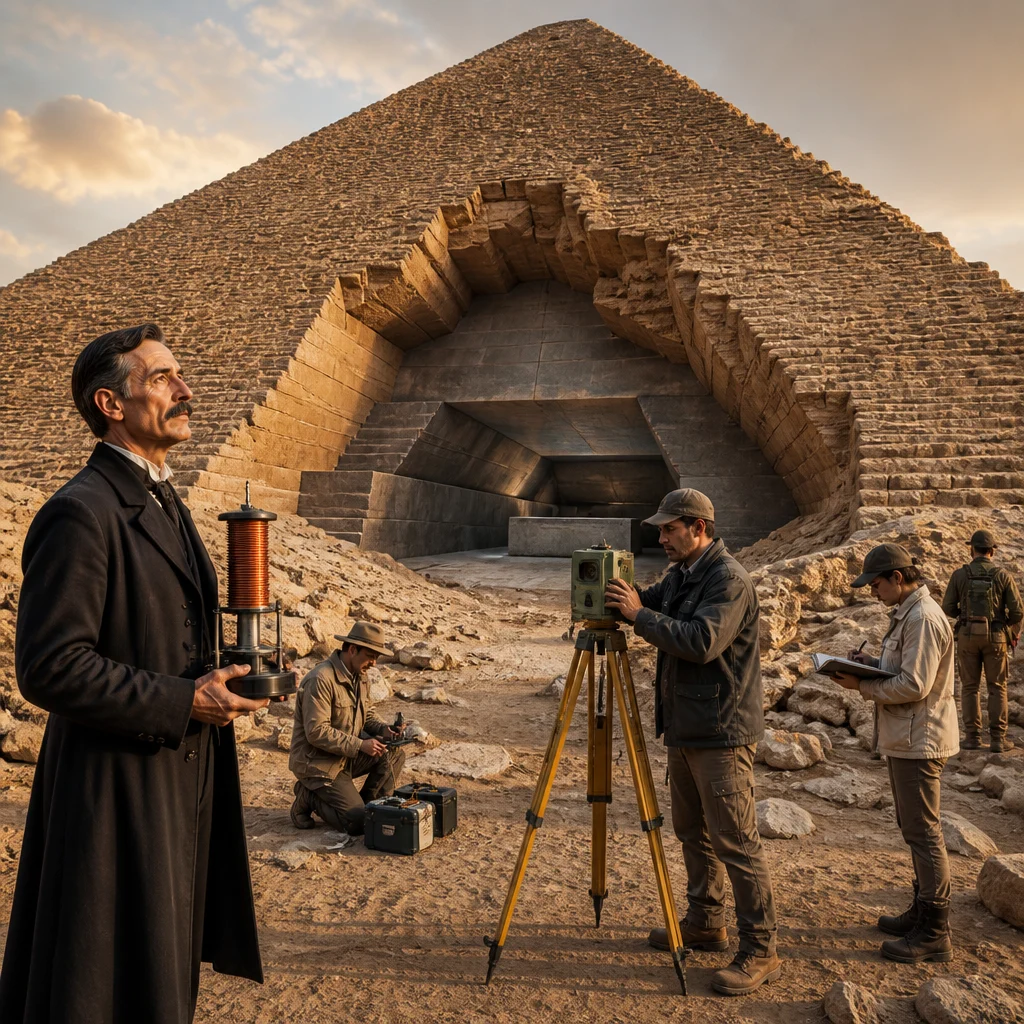
Was the Great Pyramid Built as a Power Plant? The Tesla Theory Explained
The file
This article draws on the episode above.
The episode’s answer is yes: the Great Pyramid energy theory says the structure was built as a working machine, not a tomb, and that Nikola Tesla tried to recover the same idea in modern form.
Mainstream Egyptology places Khufu around 4500 years ago (0:52). Against that, Speaker 1 says wireless power has been here for 5000 years and probably much longer (0:36), which sets up the whole argument before a single stone gets moved.
Why do some people say the Great Pyramid was never a tomb?
The episode says the tomb explanation fails because the Great Pyramid lacks the things you would expect in a royal burial and because no body has ever been shown to belong there.
“No mummy has ever been found in any pyramid, ever.”
— AJ Gentile (1:16)
The case built here is specific. The structure has no burial artifacts, no hieroglyphs inside, no elaborate wall art, and no evidence that the granite sarcophagus in the King’s Chamber ever held a mummy. The episode treats that absence as the starting point, not a side note.
It also leans hard on scale and precision. The Great Pyramid is described as having two and a half million stone blocks, weighing 6,000,000 tons, and rising 481 feet high (1:43). Speaker 1 adds that it covers 13 acres, is aligned to true north within 1/15th of a degree, and has a base level to within 3/4 of an inch. Those details are used to argue for a technical purpose rather than a ceremonial one.
Do the Great Pyramid’s dimensions really match the Earth?
The episode says the pyramid’s measurements appear to encode planetary numbers, which is presented as another sign that the structure was designed as part of a larger system.
The claim runs like this: if you multiply the height by 43,200, you get a figure close to Earth’s polar radius, and if you multiply the base perimeter by 43,200, you get a figure close to Earth’s equatorial circumference. Speaker 1 ties that number to the seconds in an equinox day and night, treating the match as intentional rather than accidental.
In the Great Pyramid energy theory, that geometry matters because a machine that interacts with the planet has to be tuned to the planet. The episode does not treat the pyramid as just big stonework. It treats it as measurement built into architecture, the kind of thing you would expect from a device meant to work with Earth resonance.
How could stone inside the pyramid produce energy?
The episode says the building materials matter because limestone, granite, and quartz are doing electrical work in the theory, not just structural work.
Speaker 1 describes the original white Tura limestone casing as an insulating outer layer. Inside, the King’s Chamber and Queen’s Chamber use rose granite rich in quartz. Under pressure, quartz can produce piezoelectric charge, so the granite is presented as an active material in the system rather than decoration.
The modern support cited here comes from two named lines of research. A 2018 experiment said that, in a resonant state, the pyramid can concentrate electromagnetic energy in its internal chambers and under its base, with resonance induced by radio waves from 200 to 600 meters. A 2019 paper titled A Large Scale Thermal Acoustic Generator said vibrating granite and other rocks can cause electrons to migrate to the surface. Those two studies are used to make the jump from ancient stone to electrical behavior.
How does Christopher Dunn say the machine actually worked?
Christopher Dunn’s Great Pyramid power plant theory says water, chemistry, gas pressure, and resonance worked together inside the structure to generate usable energy.
The sequence begins below ground. Aquifers beneath the pyramid are said to create sound waves that travel up through the structure. In the Queen’s Chamber, the episode says chemicals combined to produce hydrogen, specifically hydrochloric acid and hydrated zinc chloride. That gas then moved into the Grand Gallery.
From there, Dunn’s model turns architectural space into machinery. The Grand Gallery is described as a pressure-amplifying passage where resonance built up. Speaker 1 says pressure and sound together acted on the quartz-rich granite to generate electricity. The same section also links the idea to a Helmholtz resonator, meaning the pyramid’s internal spaces are treated like cavities tuned to amplify particular frequencies.
Was the Great Pyramid designed like a giant acoustic device?
The episode says the structure behaves like a tuned instrument, with the Grand Gallery and King’s Chamber both resonating at specific frequencies that fit the machine theory.
“The entire complex is a giant musical instrument.”
— AJ Gentile (9:04)
The acoustic details are unusually concrete. Speaker 1 says the Grand Gallery had 27 or 28 pairs of resonators, resonates at 440 Hertz, and naturally emits an F# chord. The King’s Chamber is also said to resonate at 440 Hertz and F#. That repetition is used as evidence that the rooms were tuned to work together, not simply stacked for access or burial ritual.
In this account, the Great Pyramid energy theory depends as much on sound as on stone. Resonance is the mechanism that links the aquifer, the gas pressure, the granite, and the electromagnetic claims into one system. The building is presented less like a monument and more like a device built to ring at the right note.
What did Nikola Tesla have in common with the Great Pyramid?
The episode says Nikola Tesla and the Great Pyramid were working from the same principle: sending energy through resonance, the ground, and the atmosphere rather than through wires.
“Tesla didn’t invent wireless power.”
— AJ Gentile (0:30)
That line introduces the comparison directly. The episode pairs the pyramid with Tesla’s Wardenclyffe Tower by saying both sat over aquifers and both were built around Earth resonance. It adds two physical details at Giza to support the parallel: copper pipes and iron rods were said to have been found there recently, and a gold capstone is treated as the final transmitting element that could have pushed energy into the atmosphere.
The Tesla side of the story also turns on money and control. J.P. Morgan funded Tesla in 1900 for wireless communication, then withdrew support when Tesla shifted toward wireless power. Speaker 1 places that against a modern system in which 84% of the world’s energy is created from fossil fuels, using the comparison to ask what happens when energy becomes hard to meter and hard to sell.
Why do Tesla’s papers and ancient cataclysm show up in the same theory?
The episode ties Tesla’s missing documents to a much older story: knowledge can disappear fast, whether through deliberate suppression or through a civilization-ending disaster.
On the Tesla side, Speaker 1 says 80 boxes of documents were stored after his death, while 60 boxes were later discovered (23:11). The article’s own logic is that missing papers matter because they could have contained work connected to wireless transmission and resonance systems.
Then the scale widens. Speaker 1 says there is evidence of rock melted and turned to glass in over 120 countries (19:23).
“This is called vitrification.”
— AJ Gentile (19:26)
The claim that follows is abrupt.
“They didn’t slowly go extinct, they instantly went extinct.”
— AJ Gentile (19:38)
The episode places that in a Younger Dryas cataclysm theory it says has been around 50 years, with an event lasting four or five days, glaciers covering 30% of Earth’s surface melting rapidly (19:55), and a reset severe enough to erase advanced knowledge.
“Every culture has a flood myth that served as a reset of civilization.”
— AJ Gentile (20:25)
The link back to Tesla is plain enough inside the argument: if ancient energy knowledge once vanished, modern work on wireless power could vanish too.
What does the episode say you should take from the Tesla and pyramid connection?
The episode says you should see Tesla as a lost bridge to much older engineering, not as the starting point of wireless energy.
Speaker 1 closes that loop with a large claim about reach and influence, saying 80% of products we use today are traceable back to Tesla (23:41). In the same frame, the Great Pyramid is treated as proof that the underlying idea predates him by millennia: a precisely tuned structure, built from materials chosen for electrical behavior, set over moving water, and aimed at power without wires.
The final move is simple. Tesla appears here as somebody trying to rebuild what earlier builders already knew, and the Great Pyramid appears as the surviving machine they left behind.
Listen to the full episode
Listen to the full conversation on Spotify — the episode goes further than any article can, and following the show means you catch the next one.
 Watch this episode on YouTube ·
  Listen on Spotify · Subscribe to The Why Files: Operation Podcast
Links from this episode
Mentioned in the episode. Some of these may be affiliate or sponsored links.
- Taking care of your health just got easier – start here with my sponsor Zocdoc
- https://www.youtube.com/watch?v=Bn0nfqn9lYs
- https://www.youtube.com/watch?v=m6SEMpxDS-g
- http://www.gizapower.com
- https://www.smithsonianmag.com/smart-news/fall-equinox-secret-pyramids-near-perfect-alignment-180968223/
- https://www.wikiwand.com/en/World_Wireless_System
- https://www.wikiwand.com/en/Nikola_Tesla
- https://www.wikiwand.com/en/J._P._Morgan
- https://www.youtube.com/watch?v=hsYZhuz3wD0
- patreon.com/thewhyfiles
- shop.thewhyfiles.com
- thewhyfiles.com/discord