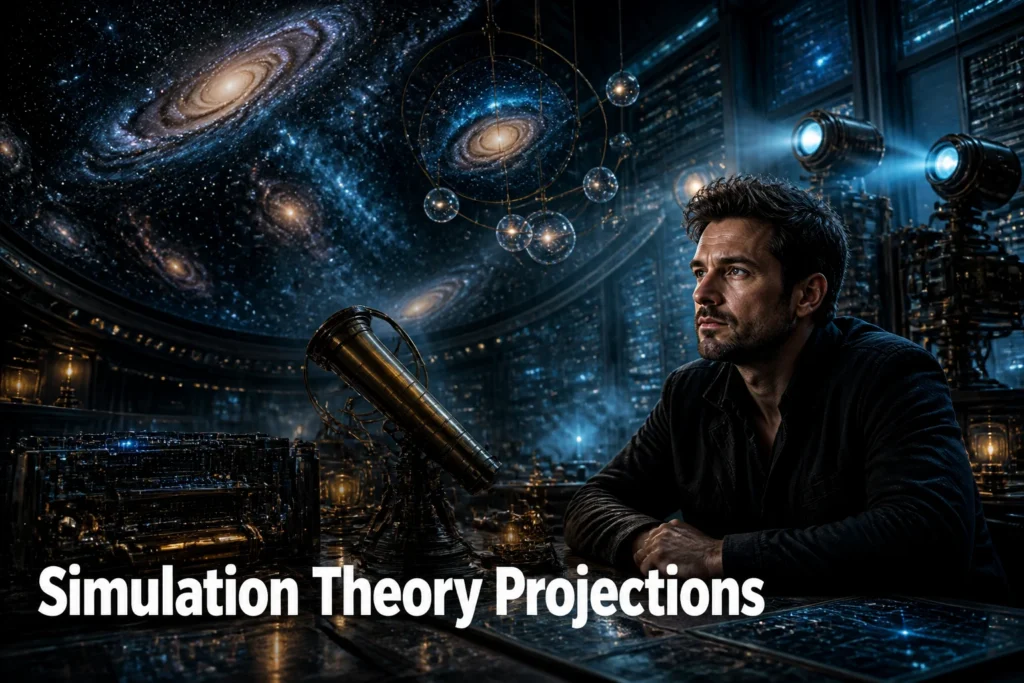
Why Simulation Theory Says Distant Galaxies Might Be Projections
The file
This article draws on the episode above.
Some galaxies could be little more than scenery until somebody looks closely, and the episode treats simulation theory as the reason that idea hangs together. The argument starts small, with a photon in a double-slit experiment, and then jumps all the way out to the night sky. If observation changes what shows up at the quantum level, the same logic can be stretched across cosmic distance: what you see from Earth does not have to mean every distant object exists in full detail all the time.
The concrete example comes from a galaxy placed 100 million light years away (18:55). The speaker pairs that with the claim that the photons we detect are reaching back through 100 million years (19:19). That is the bridge for the whole idea. You are not just talking about one weird lab result anymore; you are talking about information arriving from a place so remote that nobody inside the system can inspect it directly on demand.
How does the double-slit experiment connect to distant galaxies?
The episode connects the double-slit experiment to distant galaxies by treating both as an observation problem rather than as separate mysteries. In the lab version, a photon behaves one way when no measurement pins down its path and another way when observation does. The speaker then takes that logic and asks what happens when the photon did not come from a tabletop device, but from a galaxy so far away that the act of detection is also an act of deciding what information becomes available.
That move matters because it lets the same question run across two scales. If reality does not settle every detail until observation forces the issue, then a faraway galaxy does not need to be fully built out in advance. It only needs to produce the right observable results from your position inside the system. You see light, spectra, motion, and structure at a distance, but you do not get instant access to every star, every planet, and every grain of dust within it.
AJ Gentile puts the idea in the bluntest possible form.
“The Big Bang, that was the simulation booting up.”
— AJ Gentile (20:20)
Once the universe is framed that way, observation stops being a side effect and starts looking like part of the operating logic. The episode’s point is not that telescopes are fake. The point is that visible output and full underlying detail are not the same thing in a simulated system. A photon arriving from far away can function like a delivered result, while the remote source behind that result remains only partly specified until closer inspection demands more.
Could distant galaxies be projections instead of fully detailed places?
The episode says distant galaxies could be projections in the same sense that a video game shows mountains on the horizon before it bothers to model every rock. You get a convincing image first. Detail comes later, and only where the player can actually check it.
That is the core of the rendered-universe idea. A simulated cosmos would not need to waste processing power on regions no observer can inspect up close. It could present stars, nebulae, and galaxies as coherent large-scale images from a distance, then fill in finer structure only if somebody moved near enough or measured deeply enough to force the issue.
The speaker describes that as an excellent way to save computational resources. The analogy is not decorative; it does the heavy lifting. Modern game engines already trim detail outside the player’s immediate need. A mountain range on the horizon can be texture, lighting, and silhouette long before it becomes a fully explorable environment. The episode simply extends that logic to the cosmos. A galaxy can look complete from 100 million light years away because what reaches you is the appearance required for your vantage point, not a guarantee that every part of that galaxy is continuously rendered at maximum detail.
That also explains why the article’s title talks about projections. A projection is not nothing. It is a workable output, enough to maintain consistency for the observer who sees it. In the speaker’s version of simulation theory, distant objects still obey rules, still send light, and still fit the map of the universe. They just do not need the same ontological weight as the patch of reality you can actually probe.
Why would a simulated universe hide behind distance and the speed of light?
The episode says cosmic distance and the speed of light work like control systems: they keep simulated beings from auditing too much of reality too quickly. If you cannot cross the map fast, the system gets time to reveal only what your local situation requires.
That is where the argument ties quantum weirdness to astronomy. Observation determines what has to become definite, while distance limits how much any observer can challenge at once. A hard speed limit means you can receive signals from far away, but you cannot rush out and inspect every corner in person. The speaker treats that as suspiciously convenient from a design standpoint. If you were trying to run a universe efficiently, you would want exactly that kind of bottleneck.
The logic is simple enough to picture. From Earth, you can detect a galaxy, classify its light, and map its broad shape. What you cannot do is leap across space and verify the full internal detail of that galaxy whenever you please. So the system only needs to stay consistent at the level available to your instruments and your position. The farther away something is, the easier it is to leave it coarse. The speed of light protects that shortcut by making close inspection painfully slow.
In the episode’s framing, the same mechanism answers two headaches at once. Quantum behavior looks strange because reality firms up around observation, and the vastness of space looks strange because most of the map can remain out of reach. Put those together and you get one operating principle instead of two separate puzzles. The nearby world gets the richest detail because that is where observers live and test things. The distant universe can remain efficient, sparse, and convincing from afar, with more detail supplied only if somebody ever gets close enough to force the render.
Listen to the full episode
Listen to the full conversation on Spotify — the episode goes further than any article can, and following the show means you catch the next one.
 Watch this episode on YouTube ·
  Listen on Spotify · Subscribe to The Why Files: Operation Podcast
Links from this episode
Mentioned in the episode. Some of these may be affiliate or sponsored links.
- Taking care of your health just got easier – start here with my sponsor Zocdoc
- patreon
- shop.thewhyfiles.com
- thewhyfiles.com/discord
- 🌐 OFFICIAL WEB SITE
- thewhyfiles.com/tips
- thewhyfiles.com/merch
- thewhyfiles.com/wild
- thewhyfiles.com/podcast
- reddit.com/r/TheWhyFiles/
- twitter.com/OMGTheWhyFiles
- instagram.com/OMGTheWhyFiles