Does the Double-Slit Experiment Prove We Live in a Simulation?
The file
This article draws on the episode above.
No, the double-slit experiment does not get treated here as proof on its own; it gets treated as the sharpest clue in the simulation argument, because the experiment appears to make reality wait for observation before settling on an outcome.
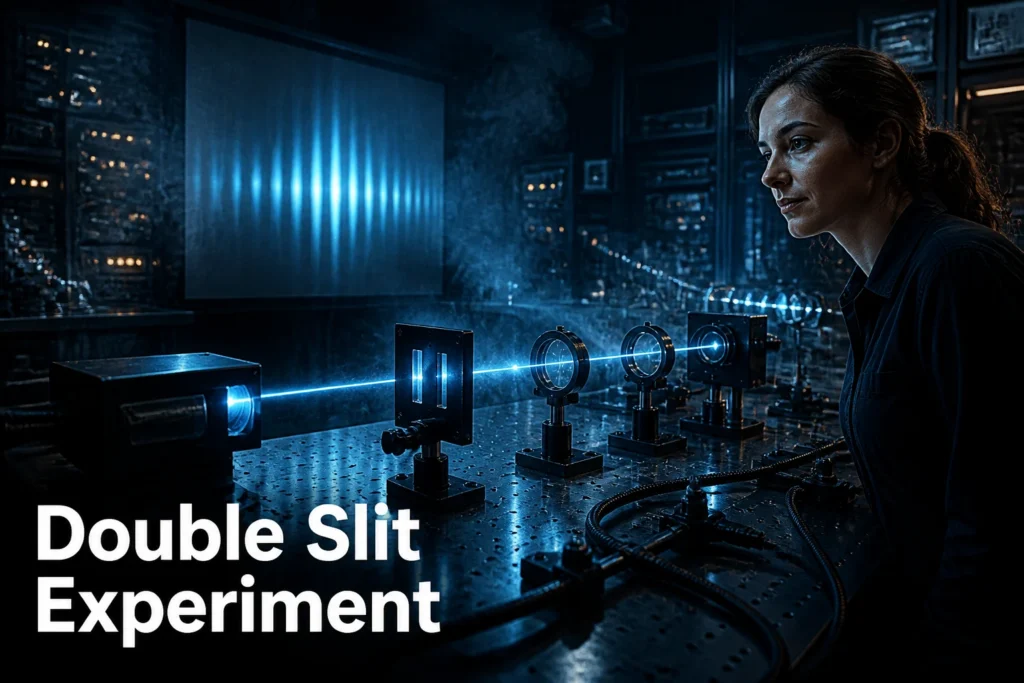
The example AJ Gentile centers is not a lab toy in isolation but light from a distant galaxy. In the setup he describes, photons from a galaxy travel toward Earth, pass through a double slit, and produce an interference pattern if nobody measures which slit each photon used. Once a measuring device observes the path, the wave pattern disappears and a definite result takes its place.
Why does the double-slit experiment matter so much to simulation theory?
The double-slit experiment matters to simulation theory because AJ Gentile treats it as a case where reality behaves differently when something is measured than when nothing checks the path.
The version he describes starts with photons arriving from a distant galaxy and heading into a two-slit setup. If those photons are left unmeasured, they produce an interference pattern, which is the wave result. If the photons go through a measuring apparatus so their path is observed, the interference pattern vanishes and the result changes to a particle-like outcome with a definite track.
That is the turn the simulation reading grabs onto. In Gentile’s framing, the world does not seem to finish specifying the particle until an observation demands an answer. He compares that to a video game engine that does not render every hidden detail all the time, but resolves what the player is actively looking at.
That comparison does the real work in the article’s title. The claim is not simply that quantum behavior looks strange. The claim is that strange behavior starts to look organized, even computational, when observation appears tied to whether the universe presents a spread of possibilities or one fixed result.
On that reading, the double slit becomes more than a physics curiosity. It becomes an example of selective resolution: reality stays open while unobserved and locks into a definite state only at measurement.
How does the distant galaxy version make the claim more dramatic?
The distant-galaxy version makes the claim more dramatic because AJ Gentile pushes the setup across cosmic distance, where the timing looks backward rather than merely weird.
He describes a galaxy that sits 100 million light years away (18:55). If photons from that galaxy are only forced into a definite path once they are measured here, the implication in his telling is not just local weirdness at the detector. The implication is that the decision appears to reach back across the whole trip.
“This is called retro causality.”
— AJ Gentile (19:17)
Gentile then states the idea in its most extreme form: observation seems to make those photons reach back 100 million years and alter their state on the far side of the galaxy (19:19). That is the point where the double-slit experiment, in his framing, stops looking like a small quantum puzzle and starts looking like a system that can update reality across time.
If you accept that framing, ordinary cause and effect no longer look sufficient. The measuring device here seems connected to what the photon was all along, even before the photon arrived. The episode uses that result as a direct bridge into the simulation theory reading, because a programmed system can treat time and state changes very differently from the way people expect matter to behave inside a purely physical world.
Why would a simulation explain quantum behavior better, according to AJ Gentile?
According to AJ Gentile, a simulation explains quantum behavior better because a program can defer outcomes, update states on demand, and ignore the ordinary limits people expect from space, time, and matter.
His analogy stays close to video games. A game does not compute every mountain, street, and room at full detail all the time. It saves processing by resolving what the player actually engages with. Gentile applies that same logic to measured particles: the universe could leave a quantum object unresolved until an observation forces a final value.
He extends that beyond the double-slit experiment to entanglement as well. In his account, quantum mechanics starts to make sense if something underneath reality is coordinating outcomes from outside the scene itself. A program would not be trapped inside the same rules as the objects it generates.
“They don’t have to follow the laws of physics.”
— AJ Gentile (20:36)
That sentence carries the whole simulation claim in compact form. If the system behind reality sits one level above the world you experience, then the things that confuse observers inside the world do not need to confuse the system running it. The episode’s argument is that quantum effects look less like broken physics and more like signs of a hidden operating layer.
That leaves the title’s answer in the form the conversation gives it: the double-slit experiment is presented not as a courtroom-style proof, but as one of the strongest clues that measurement triggers reality to resolve, the way a programmed world would.
Listen to the full episode
Listen to the full conversation on Spotify — the episode goes further than any article can, and following the show means you catch the next one.
 Watch this episode on YouTube ·
  Listen on Spotify · Subscribe to The Why Files: Operation Podcast
Links from this episode
Mentioned in the episode. Some of these may be affiliate or sponsored links.
- Taking care of your health just got easier – start here with my sponsor Zocdoc
- patreon
- shop.thewhyfiles.com
- thewhyfiles.com/discord
- 🌐 OFFICIAL WEB SITE
- thewhyfiles.com/tips
- thewhyfiles.com/merch
- thewhyfiles.com/wild
- thewhyfiles.com/podcast
- reddit.com/r/TheWhyFiles/
- twitter.com/OMGTheWhyFiles
- instagram.com/OMGTheWhyFiles