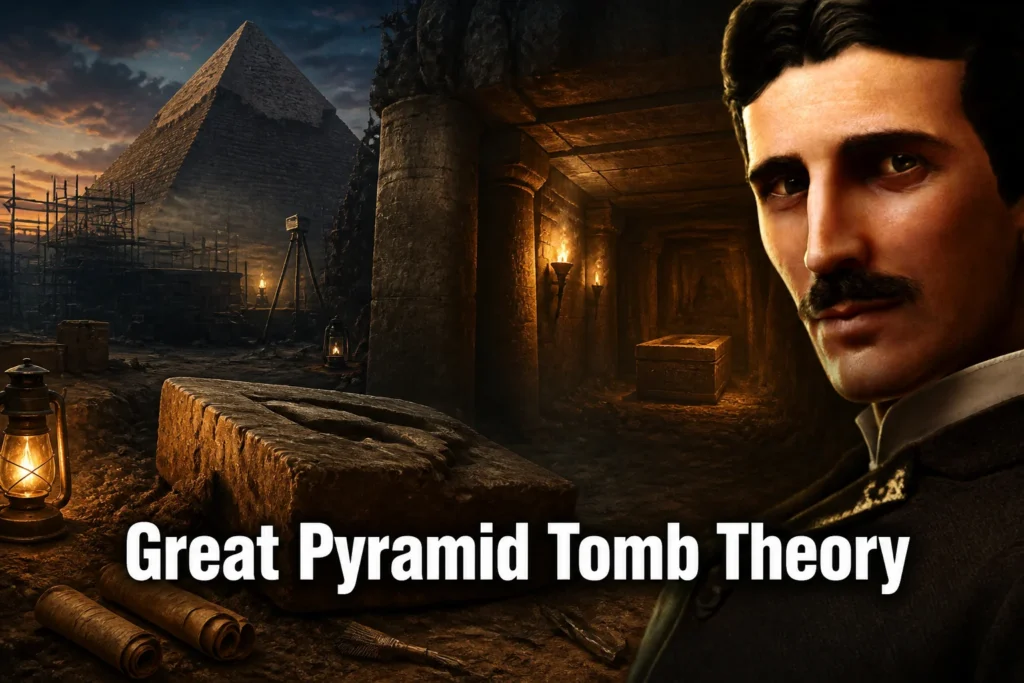
Why Some People Say the Great Pyramid Was Never a Tomb
The file
This article draws on the episode above.
People who doubt the tomb explanation for the Great Pyramid start in the same place: the Great Pyramid tomb theory asks you to accept a royal burial site with none of the things they expect to find in one.
Mainstream Egyptology places Khufu around 4500 years ago (0:52), but the case laid out here does not turn on his date alone. It turns on what is missing inside the pyramid, and on what the building itself looks like when you measure it closely.
Why do some people reject the Great Pyramid tomb theory?
Some people reject the Great Pyramid tomb theory because they say the structure lacks the usual signs of a royal burial site: no artifacts, no hieroglyphs, no elaborate wall art, and no evidence that a mummy was ever placed in the granite sarcophagus.
“No mummy has ever been found in any pyramid, ever.”
— AJ Gentile (1:16)
That claim is used to push the argument past one empty chamber or one missing body. The case being made is broader: the granite sarcophagus inside the Great Pyramid is presented as a container with no confirmed sign that it ever held a mummy, and the same absence is extended to pyramids as a class.
The missing details matter because the expected picture of an Egyptian royal tomb usually includes burial goods, inscriptions, and decoration tied to the dead ruler. Here, the argument runs the other way. Instead of a chamber rich with objects and text, the interior is described as stripped of the markers people associate with a pharaoh’s burial.
That absence becomes the first half of the challenge. If you call the Great Pyramid a tomb, the episode’s case says you still have to account for why the building does not show the features these critics think a tomb should show.
What makes the Great Pyramid look more like a functional structure than a burial monument?
The Great Pyramid is presented as a functional structure rather than a burial monument because its size and precision look, in this account, less like ceremony and more like deliberate engineering.
The measurements are the center of that claim. The structure is described as made from two and a half million blocks of stone, with a total weight of 6,000,000 tons, standing 481 feet high and covering 13 acres at its base (1:43) (1:51). Those figures are used to frame the pyramid as an object built at a scale so extreme that a simple tomb explanation feels too small for the effort involved.
The precision is treated the same way. The pyramid is described as aligned to true north within 115th of a degree, and its base is level to 3/4 of an inch (1:59). In this telling, those are not decorative achievements. They are presented as signs that the builders were solving exact problems and working to exact tolerances.
Put the two ideas together and you get the episode’s full case against the burial reading. On one side, there is an interior with no artifacts, no hieroglyphs, no elaborate wall art, and no evidence of a mummy in the granite sarcophagus. On the other, there is a building defined by mass, alignment, and extraordinary construction accuracy. The argument that follows is simple: if the Great Pyramid was only meant to house a dead king, its design looks far more exacting and purposeful than that explanation accounts for.
Listen to the full episode
Listen to the full conversation on Spotify — the episode goes further than any article can, and following the show means you catch the next one.
 Watch this episode on YouTube ·
  Listen on Spotify · Subscribe to The Why Files: Operation Podcast
Links from this episode
Mentioned in the episode. Some of these may be affiliate or sponsored links.
- Taking care of your health just got easier – start here with my sponsor Zocdoc
- https://www.youtube.com/watch?v=Bn0nfqn9lYs
- https://www.youtube.com/watch?v=m6SEMpxDS-g
- http://www.gizapower.com
- https://www.smithsonianmag.com/smart-news/fall-equinox-secret-pyramids-near-perfect-alignment-180968223/
- https://www.wikiwand.com/en/World_Wireless_System
- https://www.wikiwand.com/en/Nikola_Tesla
- https://www.wikiwand.com/en/J._P._Morgan
- https://www.youtube.com/watch?v=hsYZhuz3wD0
- patreon.com/thewhyfiles
- shop.thewhyfiles.com
- thewhyfiles.com/discord